Mostrando entradas con la etiqueta Charles Darwin. Mostrar todas las entradas

viernes, 29 de enero de 2010

Santiago.-Isla de Cabo Verde


"Después de haber tenido que retroceder dos veces, a causa de fuertes temporales del Sudoeste, el Beagle, bergantín de diez cañones, al mando del capitán Fitz Roy, de la Marina Real Inglesa, zarpó de Devonport el 27 de diciembre 1831. El objeto de la expedición era completar los trabajos de hidrografía de Patagonia y Tierra de Fuego, comenzados, bajo la dirección del King, de 1826 a 1830 - la hidrografía de las costas de Chile, del Perú y de algunas islas del Pacifico- , y efectuar una serie de medidas cronométricas alrededor del mundo. El 6 de enero llegamos a Tenerife, pero se nos prohibió desembarcar, por temor de que lleváramos el cólera; a la mañana siguiente vimos salir el Sol tras el escarpado perfil de la isla de Gran Canaria e iluminar súbitamente el Pico de Tenerife, en tanto las regiones más bajas aparecían veladas en nubes aborregadas. Este fue el primero de una serie de días deliciosos e inolvidables. El 16 de enero de 1832 anclamos en Porto Praya, en Santiago, isla principal del archipielago de Cabo Verde."

Charles Darwin
"Diario del viaje de un naturalista alrededor del mundo"

jueves, 12 de febrero de 2009

El Santa Cruz

El Santa Cruz (Fuente:The Complete Work of Charles Darwin Online)
A Naturalist's Voyage Round the World
Chapter IX
SANTA CRUZ, PATAGONIA, AND THE FALKLAND ISLANDS.
April 13th, 1834.—The Beagle anchored within the mouth of the Santa Cruz. This river is situated about sixty miles south of Port St. Julian. During the last voyage Captain Stokes proceeded thirty miles up it, but then, from the want of provisions, was obliged to return. Excepting what was discovered at that time, scarcely anything was known about this large river. Captain Fitz Roy now determined to follow its course as far as time would allow. On the 18th three whale-boats started, carrying three weeks' provisions; and the party consisted of twenty-five souls—a force which would have been sufficient to have defied a host of Indians. With a strong flood-tide and a fine day we made a good run, soon drank some of the fresh water, and were at night nearly above the tidal influence.
The river here assumed a size and appearance which, even at the highest point we ultimately reached, was scarcely diminished. It was generally from three to four hundred yards broad, and in the middle about seventeen feet deep. The rapidity of the current, which in its whole course runs at the rate of from four to six knots an hour, is perhaps its most remarkable feature. The water is of a fine blue colour, but with a slight milky tinge, and not so transparent as at first sight would have been expected. It flows over a bed of pebbles, like those which compose the beach and the surrounding plains. It runs in a winding course through a valley, which extends in a direct line westward. This valley varies from five to ten miles in breadth; it is bounded by step-formed terraces, which rise in most parts, one above the other, to the height of five hundred feet, and have on the opposite sides a remarkable correspondence.

Viaje de un naturalista alrededor del mundo
CAPÍTULO IX
El Santa Cruz, la Patagonia y las islas Falkland.
13 de abril de 1834. El Beagle echa el ancla en la desembocadura del Santa Cruz. Este río desagua en el mar a unas 60 millas al sur del puerto San Julián.
Durante su último viaje lo había remontado el capitán Stokes en una extensión de cerca de 30 millas; pero la falta de provisiones le obligó a retroceder. No se conocía de este río más que lo descubierto en la excursión de que acabo de hablar. El capitán Fitz-Roy se resuelve a penetrar todo lo que el tiempo permitiese, y partimos el 18 en tres balleneras llevando provisiones para tres semanas. Componíase nuestra expedición de 25 hombres, fuerza suficiente para desafiar a un ejército de indios. La marea ascendente nos arrastró muy pronto; el tiempo estaba bueno e hicimos una larga etapa; no tardamos en beber agua dulce del río, y por la tarde nos encontramos donde ya no se dejaba sentir la marea.
En este punto toma el río el aspecto y la anchura que conserva casi sin diferencia hasta el extremo de nuestro viaje. La anchura media es de 300 a 400 metros, y la profundidad, en el centro, 17 pies.
Uno de los caracteres más notables de este río es la constante rapidez de la corriente, que oscila entre cuatro y seis nudos por hora. El agua tiene un hermoso color azul, aunque con ligero tinte lechoso, y no es tan transparente como se cree a primera vista. Forman el lecho cantos rodados como los de las orillas y las llanuras inmediatas. Describe numerosas inflexiones en un valle que se extiende en línea recta hacia el oeste, y que tiene de cinco a diez millas de anchura; limitándolo terrazas que se elevan comúnmente por grados, unas sobre otras, hasta la altura de 500 pies, coincidiendo marcadamente en los dos lados del valle.
Viaje de un naturalista alrededor del mundo
(Traducción Manuel Vílchez de Serradel,1906)
Charles Darwin

domingo, 18 de enero de 2009

Ojeada sobre nuestro viaje

William Blake:Europe Supported By Africa & America
A Naturalist's Voyage Round the World
Chapter XXI
MAURITIUS TO ENGLAND
Retrospect on our voyage.
On the 19th of August we finally left the shores of Brazil. I thank God, I shall never again visit a slave-country. To this day, if I hear a distant scream, it recalls with painful vividness my feelings, when passing a house near Pernambuco, I heard the most pitiable moans, and could not but suspect that some poor slave was being tortured, yet knew that I was as powerless as a child even to remonstrate. I suspected that these moans were from a tortured slave, for I was told that this was the case in another instance. Near Rio de Janeiro I lived opposite to an old lady, who kept screws to crush the fingers of her female slaves. I have stayed in a house where a young household mulatto, daily and hourly, was reviled, beaten, and persecuted enough to break the spirit of the lowest animal. I have seen a little boy, six or seven years old, struck thrice with a horse-whip (before I could interfere) on his naked head, for having handed me a glass of water not quite clean; I saw his father tremble at a mere glance from his master's eye. These latter cruelties were witnessed by me in a Spanish colony, in which it has always been said that slaves are better treated than by the Portuguese, English, or other European nations. I have seen at Rio de Janeiro a powerful negro afraid to ward off a blow directed, as he thought, at his face. I was present when a kind-hearted man was on the point of separating forever the men, women, and little children of a large number of families who had long lived together. I will not even allude to the many heart-sickening atrocities which I authentically heard of;—nor would I have mentioned the above revolting details, had I not met with several people, so blinded by the constitutional gaiety of the negro as to speak of slavery as a tolerable evil. Such people have generally visited at the houses of the upper classes, where the domestic slaves are usually well treated, and they have not, like myself, lived amongst the lower classes. Such inquirers will ask slaves about their condition; they forget that the slave must indeed be dull who does not calculate on the chance of his answer reaching his master's ears.
It is argued that self-interest will prevent excessive cruelty; as if self-interest protected our domestic animals, which are far less likely than degraded slaves to stir up the rage of their savage masters. It is an argument long since protested against with noble feeling, and strikingly exemplified, by the ever-illustrious Humboldt. It is often attempted to palliate slavery by comparing the state of slaves with our poorer countrymen: if the misery of our poor be caused not by the laws of nature, but by our institutions, great is our sin; but how this bears on slavery, I cannot see; as well might the use of the thumb-screw be defended in one land, by showing that men in another land suffered from some dreadful disease. Those who look tenderly at the slave owner, and with a cold heart at the slave, never seem to put themselves into the position of the latter;—what a cheerless prospect, with not even a hope of change! picture to yourself the chance, ever hanging over you, of your wife and your little children—those objects which nature urges even the slave to call his own—being torn from you and sold like beasts to the first bidder! And these deeds are done and palliated by men who profess to love their neighbours as themselves, who believe in God, and pray that His Will be done on earth! It makes one's blood boil, yet heart tremble, to think that we Englishmen and our American descendants, with their boastful cry of liberty, have been and are so guilty; but it is a consolation to reflect, that we at least have made a greater sacrifice than ever made by any nation, to expiate our sin.

Viaje de un naturalista alrededor del mundo
CAPÍTULO XXI
De la isla Mauricio a Inglaterra.
Ojeada sobre nuestro viaje.
El 19 de agosto abandonamos en definitiva las costas del Brasil, dando ya gracias a Dios de no tener que volver a visitar países de esclavos. Todavía hoy, cuando oigo un lamento lejano me acuerdo de que el pasar por delante de una casa de Pernambuco oí quejarse; en el acto se me representó en la imaginación, y así era en efecto, que atormentaban a un pobre esclavo; pero al mismo tiempo comprendí que no podía intervenir. En Río Janeiro vivía yo en frente de casa de una señora vieja que tenía tornillos para estrujarles los dedos a sus esclavas. He vivido también en una casa en la que un joven mulato era sin cesar insultado, perseguido y apaleado con una rabia que no se emplearía contra el animal más ínfimo. Un día he visto, antes que pudiese interponerme, dar a un niño de seis o siete años tres porrazos en la cabeza con el mango de un látigo, por haberme traído un vaso que no estaba limpio; el padre del chico presenció este verdadero tormento y bajó la cabeza sin atreverse a proferir ni una palabra. Pues bien estas crueldades ocurrían en una colonia española donde se asegura que se trata a los esclavos mejor que lo hacen los portugueses, los ingleses y las demás naciones de Europa. En Río Janeiro he visto un negro, en lo mejor de la edad, no atreverse levantar el brazo para desviar el golpe que creía dirigido contra su cara. He visto a un hombre, tipo de benevolencia a los ojos del mundo, a punto de separar de los hombres, a las mujeres y a los niños que constituían numerosas familias. No aludiría a estas atrocidades de que he oído hablar, y que por desgracia son muy verdaderas, ni hubiese citado los hechos que acabo de referir, si no hubiese visto personas que, engañadas por la natural alegría del negro, hablan de la esclavitud como de un mal soportable. Esas personas no han visitado sin duda más que las casas de las clases más elevadas, donde por lo común tratan bien a los esclavos domésticos; pero no han tenido ocasión, como yo, de vivir entre las clases inferiores. Esas gentes preguntan por regla general a los mismos esclavos para saber su condición; pero se olvidan de que seria muy insensato el esclavo que al contestar no pensase en que tarde o temprano llegará su respuesta a oídos del amo.
Se asegura, es verdad, que basta el interés para impedir las crueldades excesivas; pero, pregunto yo, ¿ha protegido alguna vez el interés a nuestros animales domésticos, que mucho menos degradados que los esclavos, tienen ocasión, sin embargo, de provocar el furor de sus amos? Contra ese argumento ha protestado con gran energía el ilustre Humboldt. También se ha tratado de excusar muchas veces la esclavitud, comparando la condición de los esclavos con la de nuestros campesinos pobres. Grande es, en verdad, nuestra falta si resulta la miseria de nuestros pobres, no de las leyes naturales, sino de nuestras instituciones; pero casi no puedo comprender qué relación tiene esto con la esclavitud; ¿se podrá perdonar que en un país se empleen, por ejemplo, instrumentos a propósito para triturar los dedos de los esclavos, fundándose en que en otros países están sujetos los hombres a enfermedades tanto o más dolorosas? Los que excusan a los dueños de esclavos y permanecen indiferentes ante la posición de sus víctimas no se han puesto jamás en el lugar de estos infelices, ¡qué porvenir tan terrible, sin esperanza del cambio más ligero! ¡Figuraos cuál sería vuestra vida si tuvieseis constantemente presente la idea de que vuestra mujer y vuestros hijos -esos seres que las leyes naturales hacen tan queridos hasta a los esclavos- han de ser arrancados del hogar para ser vendidos, como bestias de carga, al mejor postor! Pues bien, hombres que profesan grande amor al prójimo, que creen en Dios, que piden todos los días que se haga su voluntad sobre la tierra, son los que toleran, ¿qué digo?, ¡realizan esos actos! ¡Se me enciende la sangre cuando pienso que nosotros, ingleses, que nuestros descendientes, americanos, que todos cuantos, en una palabra, proclamamos tan alto nuestras libertades, nos hemos hecho culpables de actos de este género! Al menos me queda el consuelo de pensar que, para expiar nuestros crímenes, hemos hecho un sacrificio mucho más grande que ninguna otra nación del mundo.
Viaje de un naturalista alrededor del mundo
(Traducción Manuel Vílchez de Serradel,1906)
Charles Darwin

jueves, 6 de noviembre de 2008

Las llanuras de la Patagonia

Llanura de la Patagonia
A Naturalist's Voyage Round the World
Chapter XXI
MAURITIUS TO ENGLAND
Among the scenes which are deeply impressed on my mind, none exceed in sublimity the primeval forests undefaced by the hand of man; whether those of Brazil, where the powers of Life are predominant, or those of Tierra del Fuego, where Death and Decay prevail. Both are temples filled with the varied productions of the God of Nature:—no one can stand in these solitudes unmoved, and not feel that there is more in man than the mere breath of his body. In calling up images of the past, I find that the plains of Patagonia frequently cross before my eyes; yet these plains are pronounced by all wretched and useless. They can be described only by negative characters; without habitations, without water, without trees, without mountains, they support merely a few dwarf plants. Why, then, and the case is not peculiar to myself, have these arid wastes taken so firm a hold on my memory? Why have not the still more level, the greener and more fertile Pampas, which are serviceable to mankind, produced an equal impression? I can scarcely analyse these feelings: but it must be partly owing to the free scope given to the imagination. The plains of Patagonia are boundless, for they are scarcely passable, and hence unknown: they bear the stamp of having lasted, as they are now, for ages, and there appears no limit to their duration through future time. If, as the ancients supposed, the flat earth was surrounded by an impassable breadth of water, or by deserts heated to an intolerable excess, who would not look at these last boundaries to man's knowledge with deep but ill-defined sensations?

Viaje de un naturalista alrededor del mundo
Capítulo XXI
De la isla Mauricio a Inglaterra.
Entre los cuadros que más honda impresión han causado en mi espíritu, ninguno tan sublime como el aspecto de las selvas vírgenes en que no hay ni vestigios de paso del hombre; sean éstas las del Brasil, donde domina la vida en toda su exhuberancia; sean las de la Tierra del Fuego, donde se enseñorea la muerte. Ambas son dos verdaderos templos llenos de todas las producciones del Dios naturaleza. Creo que no hay nadie que pueda penetrar en estas soledades inmensas sin experimentar viva emoción y sin comprender que hay en el hombre algo más que la vida animal. Cuando evoco los recuerdos del pasado, se representan en mi memoria muchas veces las llanuras de la Patagonia, a pesar de la conformidad en que se hallan todos los viajeros en afirmar que aquello no son otra cosa que miserables desiertos. Casi no pueden atribuírsele sino caracteres negativos; no hay, en efecto, habitaciones, agua, árboles ni montes; apenas se hallan algunos arbustos raquíticos. ¿Por qué, pues, han hecho en mí, y no soy único ejemplo, tanta impresión aquellos desiertos? ¿Porqué las pampas, todavía más llanas, aunque más verdes y más fértiles y que por lo menos son útiles al hombre, no me han producido impresión semejante? No trato de analizar estos sentimientos, pero en parte deben provenir del libre campo abierto a la imaginación. Las llanuras de Patagonia son ilimitadas; apenas puede atravesárselas; por eso son tan desconocidas; parece que desde hace siglos deben hallarse en el estado en que hoy se ven y que para siempre han de seguir sin cambio alguno en su superficie. Si, como suponían los antiguos, fuese la tierra plana y rodeada por una faja de agua o por desiertos, verdaderas hornazas, imposibles de atravesar, ¿quién dejaría de experimentar profunda, aunque indefinida sensación, al borde de esos límites impuestos a los conocimientos humanos?
Viaje de un naturalista alrededor del mundo
(Traducción Manuel Vílchez de Serradel,1906)
Charles Darwin

viernes, 17 de octubre de 2008

Australia

(View of Port Jackson, taken from the South Head. From ''A Voyage to Terra Australis'', by Matthew Flinders)
A Naturalist's Voyage Round the World
Chapter XIX
AUSTRALIA
January 12th, 1836.—Early in the morning a light air carried us towards the entrance of Port Jackson. Instead of beholding a verdant country, interspersed with fine houses, a straight line of yellowish cliff brought to our minds the coast of Patagonia. A solitary lighthouse, built of white stone, alone told us that we were near a great and populous city. Having entered the harbour, it appears fine and spacious, with cliff-formed shores of horizontally stratified sandstone. The nearly level country is covered with thin scrubby trees, bespeaking the curse of sterility. Proceeding farther inland, the country improves: beautiful villas and nice cottages are here and there scattered along the beach. In the distance stone houses, two and three stories high, and windmills standing on the edge of a bank, pointed out to us the neighbourhood of the capital of Australia.

Viaje de un naturalista alrededor del mundo
CAPÍTULO XIX
Australia.
12 de enero de 1836. Un viento favorable nos empuja casi al rayar el día a la entrada del Puerto Jackson. En lugar de ver un país verdegueante y cubierto de casas hermosas, acantilados amarillentos que se extienden hasta donde alcanza la vista, nos recuerdan las costas de Patagonia. Un faro solitario construido con piedras blancas es lo único que nos indica que nos acercamos a una ciudad populosa. Entramos en el puerto que nos parece grande y espacioso: está cerrado por acantilados de gres estratificado horizontalmente. El país, casi llano, está cubierto de árboles miserables: todo indica la esterilidad. A medida que avanzamos va, sin embargo, mejorando; comienzan a verse algunos hoteles hermosos, algunas fincas bonitas a orillas del mar. Más lejos todavía, casas de piedra de dos y tres pisos y molinos de viento, al extremo de un promontorio, nos indican la proximidad de la capital de Australia.
Viaje de un naturalista alrededor del mundo
(Traducción Manuel Vílchez de Serradel,1906)
Charles Darwin

jueves, 9 de octubre de 2008

El Beagle zarpa de Devonport

Captain Robert Fitz Roy R.N. and the Officers of H.M.S. Beagle:"The South-Eastern Part of Tierra del Fuego..."
A Naturalist's Voyage Round the World
ST. JAGO—CAPE DE VERD ISLANDS
After having been twice driven back by heavy south-western gales, Her Majesty's ship Beagle" a ten-gun brig, under the command of Captain Fitz Roy, R.N., sailed from Devonport on the 27th of December, 1831. The object of the expedition was to complete the survey of Patagonia and Tierra del Fuego, commenced under Captain King in 1826 to 1830--to survey the shores of Chile, Peru, and of some islands in the Pacific--and to carry a chain of chronometrical measurements round the World. On the 6th of January we reached Teneriffe, but were prevented landing, by fears of our bringing the cholera: the next morning we saw the sun rise behind the rugged outline of the Grand Canary Island, and suddenly illumine the Peak of Teneriffe, whilst the lower parts were veiled in fleecy clouds. This was the first of many delightful days never to be forgotten. On the 16th of January 1832 we anchored at Porto Praya, in St. Jago, the chief island of the Cape de Verd archipelago.

Viaje de un naturalista alrededor del mundo
San Iago.- Islas de Cabo Verde.
Después de ser dos veces rechazado por terribles tempestades del sudoeste, el buque de Su Majestad Beagle, brick de diez cañones, al mando del capitán Fitz-Roy, de la marina real, zarpó de Devonport el 27 de diciembre de 1831. El objeto de la expedición era completar el estudio de las costas de la Patagonia y de la Tierra del Fuego (comenzado bajo las órdenes del capitán King, de 1826 a 1830); levantar los planos de las costas de Chile, del Perú y de algunas islas del Pacífico, y, por último, hacer una serie de observaciones cronométricas alrededor del mundo. El 6 de enero llegamos a Tenerife, donde nos impidió desembarcar el temor de que llevásemos el cólera. A la mañana siguiente veíamos alzarse el sol tras la quebrada línea de la mayor de las islas Canarias. Ilumina de pronto el pico de Tenerife, mientras la parte inferior de la isla permanece aún oculta por ligeros vapores; primera jornada deliciosa, seguida de tantas otras cuyo recuerdo nunca se borrará. El 16 de enero de 1832 anclamos en Porto-Praya, en la isla de San Iago la mayor de las del archipiélago de Cabo Verde.

Viaje de un naturalista alrededor del mundo
(Traducción Manuel Vílchez de Serradel,1906)
Charles Darwin

lunes, 25 de agosto de 2008

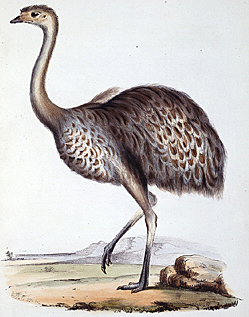
Rhea Darwinii

A Naturalist's Voyage Round the World
Chapter V
Two Species of Ostrich
When at the Rio Negro in Northern Patagonia, I repeatedly heard the Gauchos talking of a very rare bird which they called Avestruz Petise. They described it as being less than the common ostrich (which is there abundant), but with a very close general resemblance. They said its colour was dark and mottled, and that its legs were shorter, and feathered lower down than those of the common ostrich. It is more easily caught by the bolas than the other species. The few inhabitants who had seen both kinds, affirmed they could distinguish them apart from a long distance. The eggs of the small species appeared, however, more generally known; and it was remarked, with surprise, that they were very little less than those of the Rhea but of a slightly different form, and with a tinge of pale blue. This species occurs most rarely on the plains bordering the Rio Negro; but about a degree and a half farther south they are tolerably abundant. When at Port Desire, in Patagonia (lat. 48°), Mr. Martens shot an ostrich; and I looked at it, forgetting at the moment, in the most unaccountable manner, the whole subject of the Petises, and thought it was a not full-grown bird of the common sort. It was cooked and eaten before my memory returned. Fortunately the head, neck, legs, wings, many of the larger feathers, and a large part of the skin, had been preserved; and from these a very nearly perfect specimen has been put together, and is now exhibited in the museum of the Zoological Society. Mr. Gould, in describing this new species, has done me the honour of calling it after my name.

Viaje de un naturalista alrededor del mundo
Capítulo V
Dos especies de avestruces
Cuando estuve en el río Negro, en la Patagonia septentrional, a menudo me hablaban los gauchos de un ave muy rara a la cual llamaban Avestrús Petise. Menos abundante que el avestruz ordinario, muy común en esos parajes, se le asemeja mucho. Según los pocos habitantes que habían visto ambas especies, el Avestrús Petise es de un matiz más oscuro, más "tordillo" que el avestruz vulgar; tiene las piernas más cortas y sus plumas descienden más abajo; por último, se le coge mucho más fácilmente con las bolas. Añadían que las dos especies pueden distinguirse desde mucha distancia. Los huevos de la especie pequeña, sin embargo, parecen ser más generalmente conocidos, y se nota con sorpresa que se encuentran en un número casi tan cuantioso como los de la especie Rhea; son de una forma algo diferente y tienen un ligero tinte azul. Esta especie es muy rara en las llanuras colindantes con el río Negro, pero abunda mucho como grado y medio más al sur. Durante mi visita a Puerto-Deseado, en Patagonia (latitud 48º), Mr. Martens mató a una hembra de avestruz. La examiné y llegué a la conclusión de que era un avestruz común que no se había desarrollado aún por completo; cosa muy extraña y que no puedo explicármela, en aquel momento no se me ocurrió la idea de los Petises. Hízose cocer el ave y fue comida antes de venirme esto a la memoria. Por fortuna, se habían conservado la cabeza, el cuello, las patas, las alas y la mayor parte de las plumas grandes y de la piel. Por tanto, pude reconstituir un ejemplar casi perfecto, que está hoy en el Museo de la Sociedad Zoológica. Al describir Mr. Gould esta nueva especie, me ha conferido el honor de darle mi nombre.

Viaje de un naturalista alrededor del mundo
(Traducción Manuel Vílchez de Serradel,1906)
Charles Darwin

martes, 1 de julio de 2008

Tahití

A Naturalist's Voyage Round the World
Chapter XVIII
Tahiti
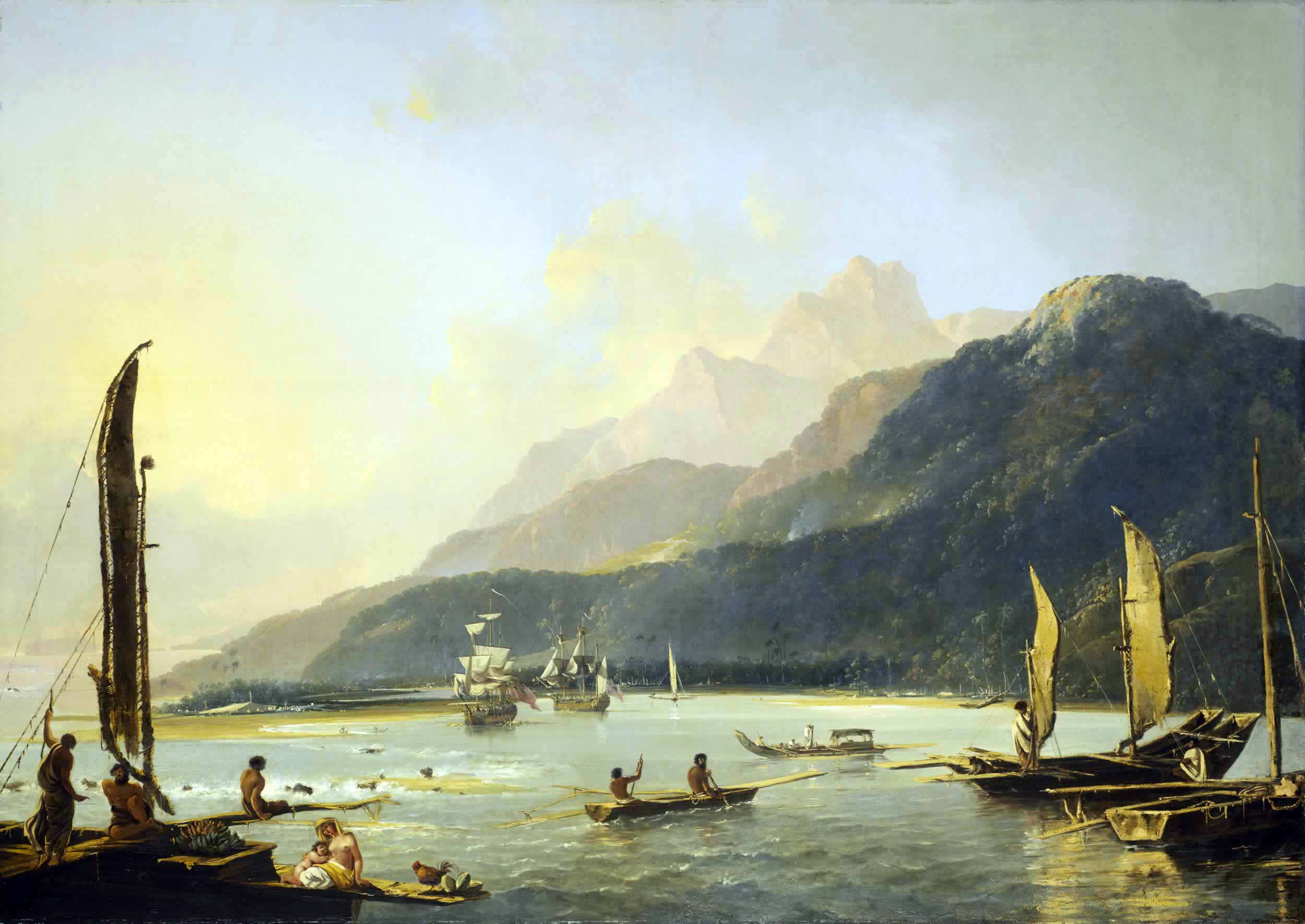
November 15th.—At daylight, Tahiti, an island which must for ever remain classical to the voyager in the South Sea, was in view. At a distance the appearance was not attractive. The luxuriant vegetation of the lower part could not yet be seen, and as the clouds rolled past, the wildest and most precipitous peaks showed themselves towards the centre of the island. As soon as we anchored in Matavai Bay, we were surrounded by canoes. This was our Sunday, but the Monday of Tahiti: if the case had been reversed, we should not have received a single visit; for the injunction not to launch a canoe on the Sabbath is rigidly obeyed. After dinner we landed to enjoy all the delights produced by the first impressions of a new country, and that country the charming Tahiti. A crowd of men, women, and children, was collected on the memorable Point Venus, ready to receive us with laughing, merry faces. They marshalled us towards the house of Mr. Wilson, the missionary of the district, who met us on the road, and gave us a very friendly reception. After sitting a short time in his house, we separated to walk about, but returned there in the evening.

Viaje de un naturalista alrededor del mundo
Capítulo XVIII
Tahití
15 de noviembre. Al rayar el día llegamos a la vista de Tahití, isla clásica para todos los viajeros del mar del sur. Vista a cierta distancia es poco atractiva: no se distingue todavía la admirable vegetación de las tierras bajas y casi no se ven, entre el celaje, más que los picos abruptos y los precipicios que forman el centro de la isla. Gran número de canoas vienen a rodear nuestro barco tan pronto como echamos el ancla en la bahía de Maravai; para nosotros es domingo, para Tahití es lunes, pues de otro modo no hubiésemos recibido ni una sola visita; porque los habitantes obedecen con exactitud la orden de no echar al mar una canoa en domingo. Después de almorzar desembarcamos para disfrutar de todas las deliciosas impresiones que produce siempre un país nuevo, y sobre todo cuando ese país es la encantadora Tahití. Una porción de hombres, de mujeres y niños, todos alegres y divertidos, se reúnen en la célebre punta Venus para recibirnos, y nos llevan a casa de Mister Wilson, misionero del distrito, que nos acoge con la mayor cordialidad. Después de descansar allí unos momentos vamos a dar un paseo.

Viaje de un naturalista alrededor del mundo
(Traducción Manuel Vílchez de Serradel,1906)
Charles Darwin

sábado, 21 de junio de 2008

La Tierra del Fuego

A Naturalist's Voyage Round the World
CHAPTER X.
TIERRA DEL FUEGO.

DECEMBER 17TH, 1832.—Having now finished with Patagonia, I will describe our first arrival in Tierra del Fuego. A little after noon we doubled Cape St. Diego, and entered the famous strait of Le Maire. We kept close to the Fuegian shore, but the outline of the rugged, inhospitable Staten land was visible amidst the clouds. In the afternoon we anchored in the bay of Good Success. While entering we were saluted in a manner becoming the inhabitants of this savage land. A group of Fuegians partly concealed by the entangled forest, were perched on a wild point overhanging the sea; and as we passed by, they sprang up, and waving their tattered cloaks sent forth a loud and sonorous shout. The savages followed the ship, and just before dark we saw their fire, and again heard their wild cry. The harbour consists of a fine piece of water half surrounded by low rounded mountains of clay-slate, which are covered to the water's edge by one dense gloomy forest. A single glance at the landscape was sufficient to show me, how widely different it was from any thing I had ever beheld. At night it blew a gale of wind, and heavy squalls from the mountains swept past us. It would have been a bad time out at sea, and we, as well as others, may call this Good Success Bay.


Viaje de un naturalista alrededor del mundo
CAPÍTULO X
La Tierra del Fuego.

17 de diciembre de 1832. Después de las observaciones sobre la Patagonia y las islas Falkland, voy a describir nuestra primera visita a la Tierra del Fuego. Un poco después del mediodía doblamos el cabo de San Diego y penetramos en el famoso estrecho de Maire. Costeamos de cerca la Tierra del Fuego, pero sin dejar de ver a través de las nubes la tormentosa silueta de la inhospitalaria tierra de los Estados. Por la tarde echamos el ancla en la bahía del Exito. A nuestra entrada recibimos un saludo digno de los habitantes de esta tierra salvaje. Un grupo de fueguenses, ocultos en parte por la espesura del bosque se había situado en una punta de la roca que dominaba el mar; en el momento de nuestro paso saltan agitando sus guiñapos y lanzando un largo y sonoro aullido. Siguen al barco, y al caer la noche distinguimos que han encendido fuego y oímos todavía sus gritos salvajes. Consiste el puerto en una hermosa sabana de agua medio rodeada de montañas, redondeadas y de poca elevación, de esquisto arcilloso, cubiertas hasta la orilla del mar por un espeso bosque. Una sola ojeada sobre el paisaje me bastó para conocer que iba a ver allí cosas distintas de las que había visto hasta entonces. Durante la noche se levanta el viento que no tarda en soplar tempestuoso, pero nos protegen de él las montañas: en el mar habríamos sufrido mucho; también nosotros, como otros muchos, podemos saludar esta bahía con el nombre de bahía del Exito.

Viaje de un naturalista alrededor del mundo
(Traducción Manuel Vílchez de Serradel,1906)
Charles Darwin

martes, 6 de mayo de 2008

Viaje de un naturalista alrededor del mundo

A Naturalist's Voyage Round the World
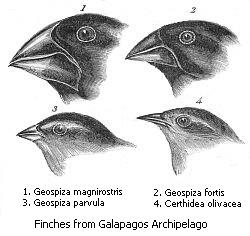
GALAPAGOS ARCHIPELAGO
September 15th.—This archipelago consists of ten principal islands, of which five exceed the others in size. They are situated under the Equator, and between five and six hundred miles westward of the coast of America. They are all formed of volcanic rocks; a few fragments of granite curiously glazed and altered by the heat can hardly be considered as an exception.
Some of the craters surmounting the larger islands are of immense size, and they rise to a height of between three and four thousand feet. Their flanks are studded by innumerable smaller orifices. I scarcely hesitate to affirm that there must be in the whole archipelago at least two thousand craters. These consist either of lava and scoriæ, or of finely-stratified, sandstone-like tuff. Most of the latter are beautifully symmetrical; they owe their origin to eruptions of volcanic mud without any lava: it is a remarkable circumstance that every one of the twenty-eight tuff-craters which were examined had their southern sides either much lower than the other sides, or quite broken down and removed. As all these craters apparently have been formed when standing in the sea, and as the waves from the trade wind and the swell from the open Pacific here unite their forces on the southern coasts of all the islands, this singular uniformity in the broken state of the craters, composed of the soft and yielding tuff, is easily explained.


Viaje de un naturalista alrededor del mundo
Archipiélago de los Galápagos.
15 de septiembre de 1835. El archipiélago de las Galápagos se compone de diez islas principales, de las cuales cinco son mucho más grandes que las otras. Está situado este archipiélago junto al Ecuador, a 500 o 600 millas al oeste de la costa de América. Todas las islas se componen de rocas volcánicas; algunos fragmentos de granito vitrificados de un modo especial y modificados por el calor constituyen apenas una excepción. Varios cráteres que coronan las islas más grandes tienen extensión considerable y se elevan a 3.000 o 4.000 pies, viéndose a los lados otros innumerables orificios menores. No dudaría en asegurar que hay por lo menos dos mil cráteres en todo el archipiélago; ora formados de lavas o escorias, ora de tobas admirablemente estratificadas y muy parecidas al gres. La mayor parte de estas tienen formas simétrica y deben su origen a erupciones de lodo volcánico sin erupción de lava, y, hecho notable, los veintiocho cráteres, compuestos de la manera que acabo de indicar y que he examinado por mí mismo, tienen el lado meridional mucho menos elevado que los otros y en algunos hasta quebrado y arrancado. Como parece casi seguro que todos estos cráteres se han formado en medio del mar, sin dificultad se explica aquel hecho en cráteres compuestos de materia tan poco resistente como la toba, por razón de que los vientos alisios y las olas procedentes del Pacífico unirían sus esfuerzos para combatir la costa meridional de todas las islas.

Viaje de un naturalista alrededor del mundo
(Traducción Manuel Vílchez de Serradel,1906)
Charles Darwin