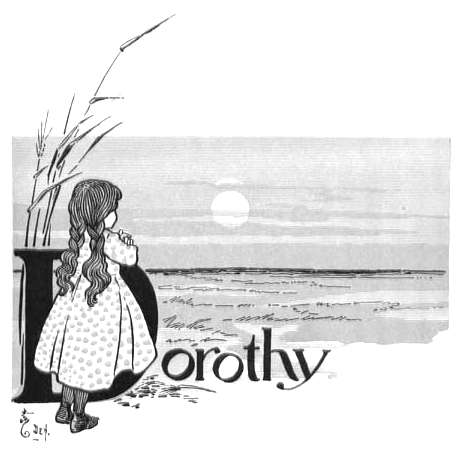
El Mago de OzDorothy lived in the midst of the great Kansas prairies, with Uncle Henry, who was a farmer, and Aunt Em, who was the farmer's wife. Their house was small, for the lumber to build it had to be carried by wagon many miles. There were four walls, a floor and a roof, which made one room; and this room contained a rusty looking cookstove, a cupboard for the dishes, a table, three or four chairs, and the beds. Uncle Henry and Aunt Em had a big bed in one corner, and Dorothy a little bed in another corner. There was no garret at all, and no cellar—except a small hole dug in the ground, called a cyclone cellar, where the family could go in case one of those great whirlwinds arose, mighty enough to crush any building in its path. It was reached by a trap door in the middle of the floor, from which a ladder led down into the small, dark hole.
When Dorothy stood in the doorway and looked around, she could see nothing but the great gray prairie on every side. Not a tree nor a house broke the broad sweep of flat country that reached to the edge of the sky in all directions. The sun had baked the plowed land into a gray mass, with little cracks running through it. Even the grass was not green, for the sun had burned the tops of the long blades until they were the same gray color to be seen everywhere. Once the house had been painted, but the sun blistered the paint and the rains washed it away, and now the house was as dull and gray as everything else.
When Aunt Em came there to live she was a young, pretty wife. The sun and wind had changed her, too. They had taken the sparkle from her eyes and left them a sober gray; they had taken the red from her cheeks and lips, and they were gray also. She was thin and gaunt, and never smiled now. When Dorothy, who was an orphan, first came to her, Aunt Em had been so startled by the child's laughter that she would scream and press her hand upon her heart whenever Dorothy's merry voice reached her ears; and she still looked at the little girl with wonder that she could find anything to laugh at.
Uncle Henry never laughed. He worked hard from morning till night and did not know what joy was. He was gray also, from his long beard to his rough boots, and he looked stern and solemn, and rarely spoke.
It was Toto that made Dorothy laugh, and saved her from growing as gray as her other surroundings. Toto was not gray; he was a little black dog, with long silky hair and small black eyes that twinkled merrily on either side of his funny, wee nose. Toto played all day long, and Dorothy played with him, and loved him dearly.
Dorothy vivía en medio de las grandes praderas de Kansas con tío Henry, que era granjero, y con tía Em, que era la mujer del granjero. Su casa era pequeña porque para construirla habían tenido que transportar la madera en una carreta desde una distancia de muchos kilómetros. Había cuatro paredes, un piso y un techo, que completaban una habitación; y en esa habitación había una oxidada cocina de hierro, una alacena para los platos, una mesa, tres o cuatro sillas y las camas. Tío Henry y tía Em tenían una grande en un rincón, y Dorothy tenía una pequeña en otro rincón. No había buhardilla ni sótano, sólo un agujero cavado en el suelo, llamado «el sótano de los ciclones», donde podría refugiarse la familia si se levantara uno de esos potentes remolinos que se llevan las casas a su paso. Se entraba al agujero –un agujero pequeño y oscuro– por una trampa situada en el centro del piso, de la que descendía una escalera.
Cuando Dorothy salía a la puerta y miraba alrededor no veía otra cosa que la inmensa pradera gris. No había un solo árbol o casa que alterase la ancha llanura que se extendía hasta el borde del cielo en cualquier dirección. El sol había calcinado la tierra arada, que era ahora una masa gris surcada por pequeñas grietas. Ni siquiera la hierba era verde, pues el sol había quemado las puntas de las largas briznas hasta dejarlas del mismo color que todo lo demás. En otra época la casa había estado pintada, pero el sol y la lluvia se habían llevado esa pintura y ahora era tan deslucida y gris como el resto de la llanura.
Cuando tía Em fue a vivir a ese sitio era una mujer joven y bonita. A ella también la habían cambiado el viento y el sol. Le habían arrebatado el brillo de los ojos, que ahora eran de un gris apagado; le habían arrebatado el color de las mejillas y los labios, que también eran grises. Ahora era una mujer delgada que no sonreía nunca. Cuando Dorothy, que era huérfana, fue a vivir con ellos, tía Em se sobresaltaba tanto cada vez que llegaba a sus oídos la risa alegre de la niña que lanzaba un grito y se llevaba una mano al corazón; y todavía se maravillaba de que la niña encontrase cosas de que reírse.
Tío Henry no se reía nunca. Trabajaba duro de sol a sol y no conocía la alegría. Él también era gris, desde la larga barba hasta las toscas botas; tenía expresión severa y solemne y casi nunca hablaba.
Quien hacía reír a Dorothy y la salvaba de volverse tan gris como todos los que la rodeaban era Totó. Totó no era gris; era un perrito negro, de pelo largo y sedoso y pequeños ojos negros que centelleaban con alegría a ambos lados de la divertida y diminuta nariz. Totó jugaba todo el tiempo, y Dorothy jugaba con él y lo quería con pasión.
(Traducción:Marcial Souto)
L.Frank Baum


.jfif)







 Entradas